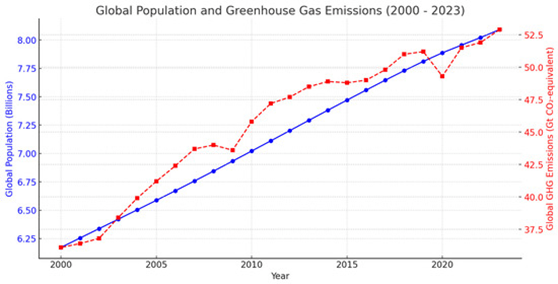
–Klimatförändringarna och ökningen av växthusgaserna är intimt kopplade till hur många människor vi är på vår planet–
Koldioxidhalterna stiger främst på grund av de fossila bränslen som människor eldar för energi. Fossila bränslen som kol och olja innehåller kol som växter drog ut ur atmosfären genom fotosyntes under miljoner år; vi återför det kolet till atmosfären på bara några hundra år. Sedan mitten av 1900-talet har de årliga utsläppen från förbränning av fossila bränslen ökat varje decennium, från nära 11 miljarder ton koldioxid per år på 1960-talet till uppskattningsvis 36,6 miljarder ton år 2023 enligt Global Carbon Budget 2023. Det finns en direkt relation mellan mänskliga utsläpp av växthusgaserna och den totala energiförbrukningen för en växande global befolkning.
En översiktsartikel som kom 2025-04-01 ger en aktuell genomgång om hur befolkningsökningen och klimatförändringarna är relaterade: Alon Tal: Överbefolkningens miljöpåverkan. Encyclopedia 2025 , 5 (2), 45 https://doi.org/10.3390/encyclopedia5020045
några länkar med abstract:
https://joint-research-centre.ec.europa.eu/jrc-news-and-updates/demography-and-climate-change-new-study-explores-links-between-two-mega-trends-our-century-2023-06-05_en A new Joint Research Centre (JRC) study with accompanying video explores the connections, opportunities and challenges of demographic and climate change, and how these can be considered in EU climate policymaking.
2023-06-05 https://publications.jrc.ec.europa.eu/repository/handle/JRC133580 Demography and climate change:
Demography is intimately related to both climate change adaptation and mitigation. The report focuses on demography and climate mitigation through analyses of trajectories for emissions and population at global and EU levels. At the global level, the report highlights the role of population momentum. While population growth implies almost by definition higher emissions, at least in the short term, the intrinsic inertia in demographic processes implies that solutions to reduce emissions need to come from reducing inequalities, the greening of the economy and a change in consumption rather than from interventions on fertility. At the EU level, the report finds that although in absolute terms older people emit less, they have higher per capita emissions, a greater share of their emissions is concentrated in carbon-intensive consumption items and they are less likely to change their attitudes or behaviour towards more environmentally friendly patterns. Considering the trends for the ageing of the EU population, these intergenerational differences in consumption and attitudes add a new policy challenge to the already pressing need to reduce the differences in responsibilities for emissions linked to income.
2023 https://populationconnection.org/resources/population-and-climate/The Connections Between Population and Climate Change:
Climate change is one of humanity’s most critical challenges. The warming of the planet threatens food security, freshwater supply, and human health. The effects of climate change, including sea level rise, droughts, floods, and extreme weather, will be more severe if actions are not taken to dramatically reduce emissions of greenhouse gases into the atmosphere]. While the link between human action and the planet’s recent warming remains an almost unanimous scientific consensus, the links between population growth and climate change deserve further exploration.
In 2023, the global population surpassed 8 billion. With 1 billion people projected to be added to our human ranks by 2040 and an additional 1 billion more by 2060, demographic trends and variables play an important role in understanding and confronting the world’s climate crisis. Population growth, along with increasing consumption, tends to increase emissions of climate-changing greenhouse gases. Rapid population growth worsens the impacts of climate change by straining resources. It also exposes more people to climate-related risks. Including population dynamics in climate change-related education and advocacy can help clarify why improving access to reproductive health care, family planning options, girls’ education, and gender equity are important climate mitigation strategies. Increased investment in health and education, along with improvements in infrastructure and land use, would strengthen climate resilience and build adaptive capacity.
2022-03-01 https://www.sciencedirect.com/science/article/pii/S1674283422000630 Population increase impacts the climate, using the sensitive Arctic as an example:
The global population during the last 100 years has increased from 2 to 7.7 billion, causing an increase in greenhouse gases in the atmosphere. In order to see how population increase is directly related to physical variables of the climate, this Perspective article places observations and scenarios of climate change into context and puts forth a statistical modeling study on how the sensitive Arctic climate responds to the increasing population. The relationships between population, Arctic sea-ice extent (SIE), and surface air temperature (SAT) are very strong, with the increasing population explaining 96% of the decreasing SIE and about 80% of the increasing SAT in the Arctic. Our projection for the SIE using the population as a “proxy predictor” for a projected population of 10 billion people on the Earth in 2100, yields a SIE of 9.30 and 8.21 million km2 for a linear and squared relationship, respectively, indicating no “tipping point” for the annual ice extent in this century. This adds another dimension to climate understanding for the public at large using population as a proxy variable, instead of the more abstract CO2 parameter. This also indicates that it is important to attempt to limit the ongoing increase in population, which is the main cause of the greenhouse gas emissions, in addition to reducing per capita emissions by an exponential in crease in implementing renewable energy, a formidable challenge in this century.
2022-12-22 https://www.populationmedia.org/the-latest/population-growth-and-climate-change How Is Population Growth Related to Climate Change?
Two of the major concerns facing the world today are overpopulation and climate change. While at first glance these two issues may appear unrelated, the truth is that they are inextricably linked. Overpopulation is directly contributing to climate change, and that, in turn, is causing devastating effects, especially in communities with less wealth. Recognizing the relationship of overpopulation to climate change is key to solving both issues. Overpopulation is filling our dumps with plastic, overpopulation is causing deforestation across the world, overpopulation is causing massive pollution by dependence on fossil fuels. Overpopulation means more factory farms, more consumption and the earth cannot handle much more. In my humble opinion, one can’t address climate.
2021-11-09 https://www.ucsusa.org/resources/climate-change-and-population Climate Change and Population: Here are the facts: climate change is caused by the heat-trapping emissions produced when we burn coal, oil, and gas, and cut down forests. Data show that these emissions are most closely connected to carbon-intensive production and consumption patterns, predominantly the carbon-intensive lifestyles of the relatively wealthy, both here in the United States and around the world. Fossil fuel companies, utilities, and their trade groups also bear significant responsibility: they have used their power, money and deceptive tactics to lock in carbon-intensive infrastructure and constrain choices individuals can make about their energy supply.
2021-11-09 https://www.ucsusa.org/resources/climate-change-and-population Climate Change and Population:
Here are the facts: climate change is caused by the heat-trapping emissions produced when we burn coal, oil, and gas, and cut down forests. Data show that these emissions are most closely connected to carbon-intensive production and consumption patterns, predominantly the carbon-intensive lifestyles of the relatively wealthy, both here in the United States and around the world. Fossil fuel companies, utilities, and their trade groups also bear significant responsibility: they have used their power, money and deceptive tactics to lock in carbon-intensive infrastructure and constrain choices individuals can make about their energy supply.
2018-08-17 https://www.science.org/doi/10.1126/science.aat8680 Global warming policy: Is population left out in the cold?
Would slowing human population growth lessen future impacts of anthropogenic climate change? With an additional 4 billion people expected on the planet by 2100, the answer seems an obvious “yes.” Indeed, substantial scientific literature backs up this intuition. Many nongovernmental organizations undertake climate- and population-related activities, and national adaptation plans for most of the least-developed countries recognize population growth as an important component of vulnerability to climate impacts. But despite this evidence, much of the climate community, notably the Intergovernmental Panel on Climate Change (IPCC), the primary source of scientific information for the international climate change policy process, is largely silent about the potential for population policy to reduce risks from global warming. Though the latest IPCC report includes an assessment of technical aspects of ways in which population and climate change influence each other, the assessment does not extend to population policy as part of a wide range of potential adaptation and mitigation responses. We suggest that four misperceptions by many in the climate change community play a substantial role in neglect of this topic, and propose remedies for the IPCC as it prepares for the sixth cycle of its multiyear assessment process.
 Nätverket Population Matters Sweden